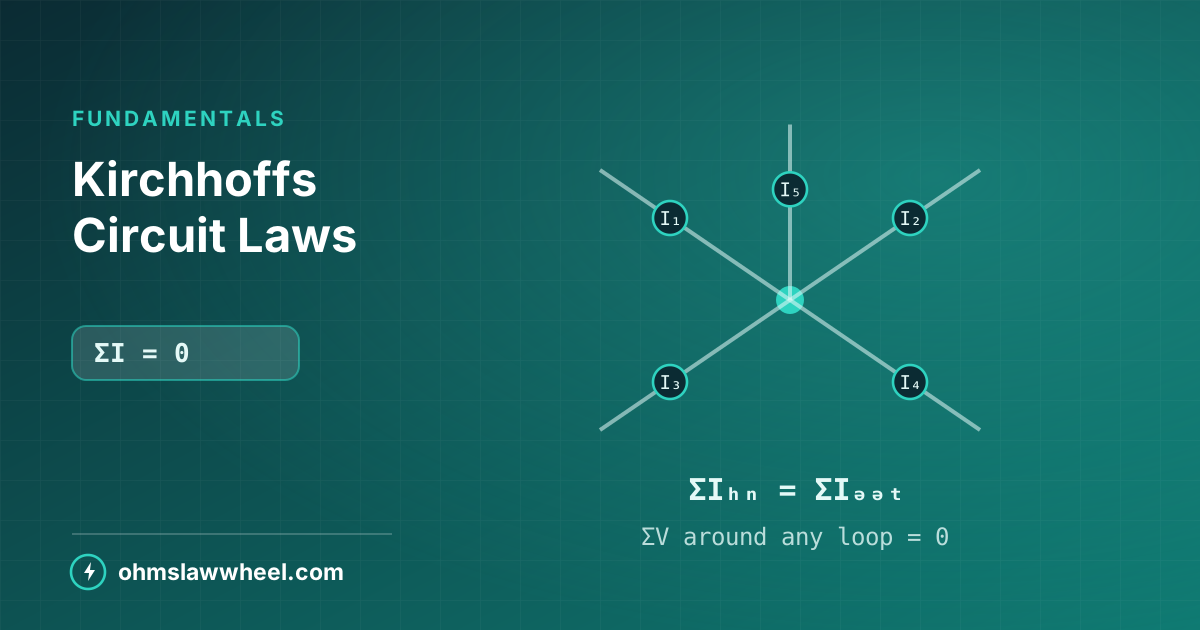
Key takeaways
- KCL: current into a junction equals current out of it.
- KVL: voltages around any closed loop sum to zero.
- Both follow from conservation — of charge and of energy.
- Pick a current direction, stay consistent, and let a negative answer tell you it was backwards.
Kirchhoff's current law (KCL)
At any junction, the total current arriving equals the total current leaving:
- ΣIₙ = ΣIₔₙₜ
Charge cannot pile up at a point in a wire, so whatever flows in must flow out. If three branches meet and two carry 0.4 A and 0.7 A inward, the third carries 1.1 A outward.
Why it matters for parallel circuits
KCL is the reason parallel branches share current in inverse proportion to their resistance. The parallel resistor calculator applies exactly this rule when it reports per-branch currents.
Kirchhoff's voltage law (KVL)
Around any closed loop, the algebraic sum of all voltages is zero:
- ΣV = 0
Every volt supplied by a source is dropped across the components in the loop. Walk a loop, add the rises, subtract the drops, and you must arrive back at zero — because you are back where you started.
Sign convention
- Moving through a source from − to +, the voltage is a rise (positive).
- Moving through a resistor with the assumed current direction, it is a drop (negative).
- Choose one direction per loop and never change it mid-calculation.
Series Resistor CalculatorReduce a chain of resistors before applying the loop rule, and check your total in one step.
A worked two-loop example
A 12 V source feeds R₁ = 100 Ω in series with a parallel pair, R₂ = 220 Ω and R₃ = 330 Ω.
Step 1 — reduce the parallel pair
1 ÷ (1/220 + 1/330) = 132 Ω
Step 2 — apply KVL to the outer loop
12 = I × (100 + 132), so I = 12 ÷ 232 = 51.7 mA.
Step 3 — find the branch voltages
- Across R₁: 0.0517 × 100 = 5.17 V
- Across the pair: 0.0517 × 132 = 6.83 V
- Check: 5.17 + 6.83 = 12 V ✓
Step 4 — apply KCL to the branch currents
| Branch | Resistance | Voltage | Current |
|---|---|---|---|
| R₂ | 220 Ω | 6.83 V | 31.0 mA |
| R₃ | 330 Ω | 6.83 V | 20.7 mA |
| Total | 132 Ω | 6.83 V | 51.7 mA |
31.0 + 20.7 = 51.7 mA, matching the current from step 2. KCL confirms the arithmetic.
Practical tips
- Label everything before you calculate. Draw arrows for assumed current directions on the schematic itself.
- Negative results are fine. They mean the real current flows opposite to your arrow; the magnitude is still correct.
- Count your equations. You need as many independent equations as unknowns — usually one KCL per junction minus one, plus one KVL per independent loop.
- Reduce first where you can. Series and parallel shortcuts turn many networks into a single loop.
Both laws assume lumped components and negligible magnetic coupling — true for ordinary DC and low-frequency AC work, and for every circuit the calculators on this site handle.
A checklist for setting up the equations
Most Kirchhoff errors happen before any arithmetic, in the setup. Working through the same checklist each time removes them.
- Redraw the circuit cleanly. Tangled schematics hide which nodes are actually the same point.
- Mark every node. Two points joined only by wire are one node, however far apart they are drawn.
- Assign current arrows first. Direction can be arbitrary, but it must be fixed before you write anything down.
- Choose loops that each include something new. A loop covering only branches you have already used adds no information.
- Count unknowns and equations. They must match, or the system cannot be solved.
Common traps
- Changing a current direction partway through, which silently flips a sign.
- Treating a voltage source as a short circuit when walking a loop.
- Forgetting that an ammeter in a branch does not change the topology.
Where Kirchhoff meets Ohm
Kirchhoff's laws tell you how currents and voltages distribute; Ohm's law converts between them. In practice you alternate: KCL and KVL to set up the relationships, then the ohms law formulas to turn them into numbers. The V-I-R-P solver handles that final step for you.
Frequently asked questions
What are Kirchhoffs two circuit laws?
The current law says the sum of currents entering a junction equals the sum leaving. The voltage law says the sum of all voltages around any closed loop is zero.
When do I need Kirchhoffs laws instead of Ohms law?
Whenever a circuit cannot be reduced to a single equivalent resistance — bridge networks, circuits with more than one source, or any topology that is neither purely series nor purely parallel.
What if my calculated current comes out negative?
It simply means the actual current flows opposite to the direction you assumed. Keep the magnitude and reverse the arrow.