Key takeaways
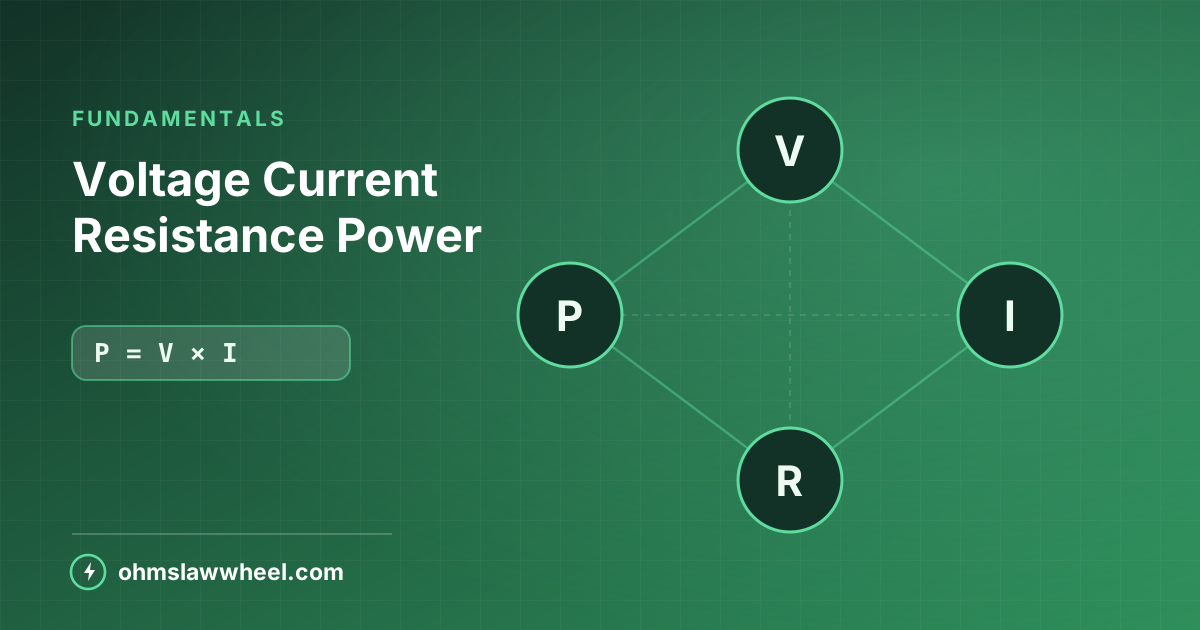
- Voltage is the push, current is the flow, resistance is the opposition, power is the rate of energy transfer.
- Raise voltage across a fixed resistance and current rises with it; power rises with the square of voltage.
- Only two of the four need measuring — the rest follow.
The four quantities, one at a time
Voltage — the push
Voltage is the difference in electrical potential between two points, measured in volts. It is always measured across something. A 9 V battery has nine volts between its terminals; the figure means nothing until you name both points.
Current — the flow
Current is the rate at which charge moves past a point, measured in amperes. One ampere is one coulomb per second. Current is measured through a component, so a meter has to be placed in series with it.
Resistance — the opposition
Resistance is how strongly a material opposes current, measured in ohms. It depends on the material, its length, its cross-section and its temperature — the relationship covered in our guide to the resistivity of copper.
Power — the rate of energy transfer
Power is how fast energy is converted, measured in watts. One watt is one joule per second. Power is what heats a resistor, lights a lamp and turns a motor.
The water analogy, and where it breaks
Voltage is like pressure, current like flow rate, resistance like a narrow pipe. The analogy is useful for intuition but it fails for anything involving fields, capacitance or inductance — treat it as a starting point, not a model.
How they interact
| Change | Held fixed | Current | Power |
|---|---|---|---|
| Double the voltage | Resistance | ×2 | ×4 |
| Double the resistance | Voltage | ×0.5 | ×0.5 |
| Double the current | Resistance | ×2 | ×4 |
| Halve the resistance | Current | — | ×0.5 |
The row that surprises people is the first: because P = V² ÷ R, doubling the supply voltage quadruples the heat in a fixed resistor. That is why a component rated for 12 V can fail immediately on 24 V.
Try the V-I-R-P SolverFill in any two boxes and the solver returns the other two, with the formula it used.
Measuring each quantity
- Voltage — meter in parallel, across the component, circuit powered.
- Current — meter in series, circuit broken and the meter inserted into the gap.
- Resistance — component isolated and de-energised. See measuring resistance with a multimeter.
- Power — usually calculated rather than measured, from any two of the others.
Never place a meter set to amps across a voltage source. The current range is a near short circuit and will blow the meter's fuse — or worse.
Putting the four together
Consider a 12 V LED strip drawing 1.5 A:
- Power: 12 × 1.5 = 18 W
- Equivalent resistance: 12 ÷ 1.5 = 8 Ω
Now suppose the supply sags to 11.4 V because of a long, thin cable. Current falls to 1.43 A and power drops to 16.3 W — nearly a tenth of the brightness lost to the wiring. Our voltage drop calculator shows how quickly that happens over distance.
Typical values worth recognising
Part of building intuition is knowing what a normal figure looks like, so an abnormal one stands out immediately.
| Situation | Voltage | Current | Power |
|---|---|---|---|
| Logic signal | 3.3 V | µA to mA | < 0.1 W |
| Indicator LED | 2 - 3 V | 5 - 20 mA | ~0.05 W |
| USB charger | 5 V | 0.5 - 3 A | 2.5 - 15 W |
| Car headlamp | 12 V | 4 - 5 A | 55 W |
| Domestic kettle | 230 V | 9 - 10 A | 2200 W |
If a calculation puts a logic pin at 2 A or a kettle at 20 mA, the arithmetic is wrong long before the hardware is. Checking the magnitude against a table like this catches more errors than re-checking the algebra does.
Where to go next
Once these four are comfortable, the next step is circuits with more than one component. Kirchhoff's circuit laws extend the same ideas to any network, and the calculators at Ohms Law Wheel handle the arithmetic while you concentrate on the reasoning.
Frequently asked questions
What is the difference between voltage and current?
Voltage is the potential difference that pushes charge, measured across a component. Current is the resulting flow of charge, measured through it. You can have voltage with no current, but never current without voltage.
Is power the same as energy?
No. Power is the rate of energy transfer in watts; energy is power multiplied by time, billed in kilowatt-hours. A 2 kW heater running 30 minutes uses 1 kWh.
Why does doubling voltage quadruple power?
Because P = V² ÷ R. Doubling V doubles the current as well, and power is the product of the two, so the effect compounds.