Key takeaways
- The wheel has four quadrants, one for each quantity you might be solving for.
- Each quadrant holds three formulas, giving twelve in total.
- You only ever need two known values to find the other two.
- The outer ring tells you which formula to use; the inner ring names the target.
What the ohms law wheel chart actually shows
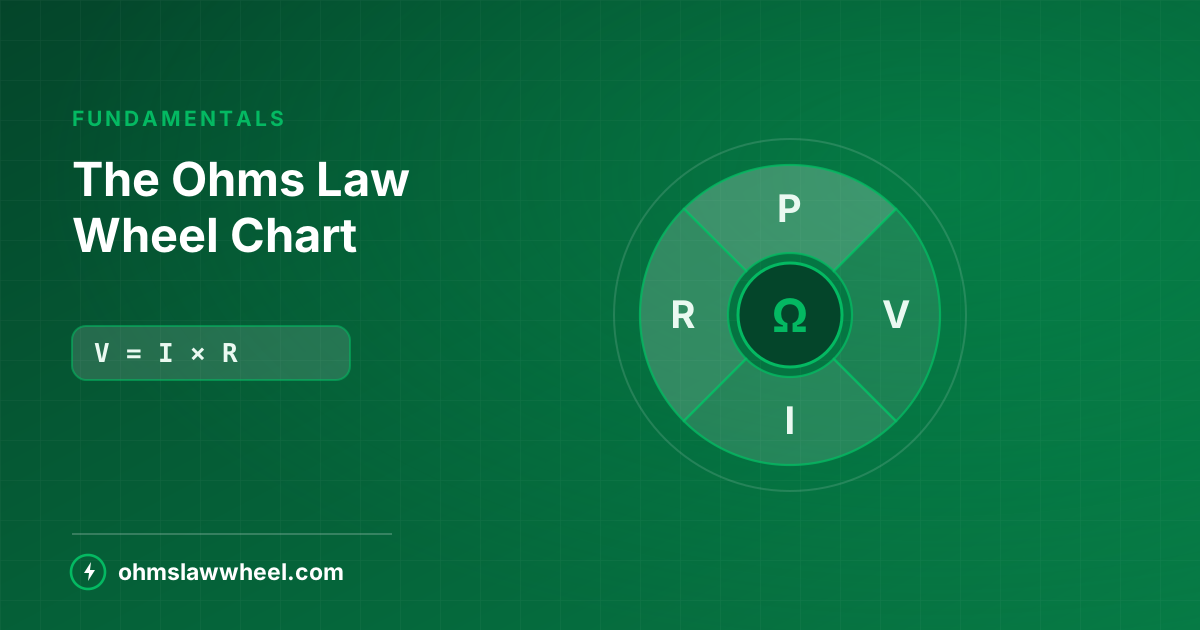
A standard ohms law wheel is a circle split into four quadrants labelled V (voltage, in volts), I (current, in amperes), R (resistance, in ohms) and P (power, in watts). The quantity you want sits in the middle of its quadrant. The three segments around it are the three different ways of calculating it.
That structure exists because Ohm's law and the power law together give you four variables linked by two equations. Any two known values pin down the remaining two — and the wheel simply pre-solves every rearrangement so you do not have to.
The two laws behind all twelve formulas
- V = I × R — Ohm's law, published by Georg Ohm in 1827.
- P = V × I — the electrical power law.
Substitute one into the other and every remaining formula on the chart falls out. Nothing on the wheel is new physics; it is bookkeeping that saves you time.
All twelve formulas, quadrant by quadrant
| Solving for | From V and I | From V and R | From I and R | From P |
|---|---|---|---|---|
| Voltage (V) | — | — | V = I × R | V = P ÷ I | V = √(P × R) |
| Current (A) | — | I = V ÷ R | — | I = P ÷ V | I = √(P ÷ R) |
| Resistance (Ω) | R = V ÷ I | — | — | R = V² ÷ P | R = P ÷ I² |
| Power (W) | P = V × I | P = V² ÷ R | P = I² × R | — |
Reading the table
Find the row for what you want, then move across to the column matching what you know. If you have voltage and resistance and you want power, the row is Power and the answer is P = V² ÷ R.
Open the Ohms Law WheelThe interactive wheel on our home page highlights the three formulas for whichever quantity you click.
How to use the wheel in practice
Step 1 — list what you know
Write the two known values with their units. Mixing millivolts with amperes is the single most common source of wrong answers, so convert everything to base units first: volts, amperes, ohms and watts.
Step 2 — find your target quadrant
Locate the quadrant for the quantity you need. On our interactive wheel, clicking a quadrant highlights it and lists its three formulas beside the solver.
Step 3 — pick the formula that uses your two knowns
Only one of the three formulas in a quadrant will use exactly the values you have. That is the one to use.
A worked example
A heating element draws 6 A from a 230 V supply. What is its resistance and power?
- Resistance: R = V ÷ I = 230 ÷ 6 = 38.3 Ω
- Power: P = V × I = 230 × 6 = 1380 W
Two knowns, two answers, no algebra. You can check both instantly in the Ohms Law Calculator.
Where the wheel stops being enough
The wheel assumes a single resistance carrying a steady direct current. It still applies to AC circuits, but only with RMS values and only where the load is purely resistive — heaters and incandescent lamps, not motors or transformers.
- For networks of several resistors, reduce them first with the series or parallel calculators, then apply the wheel to the equivalent value.
- For long cable runs, the conductor's own resistance matters — see our guide to calculating voltage drop.
- For reactive AC loads you need impedance and power factor, which the wheel does not cover.
Three habits that make the wheel automatic
People who use the chart daily share the same three habits, and none of them involve memorising formulas.
- Write the units beside every number. If the units cancel to the unit you want, the formula is right. Volts divided by ohms leaves amperes; volts times amperes leaves watts.
- Estimate before you calculate. A 230 V circuit with a few hundred ohms of load will draw somewhere near an amp. If the answer comes out at 50 A, look again at the decimal point.
- Solve for the quantity you can verify. Current is easy to check with a clamp meter; resistance usually is not, because it must be measured with the circuit dead.
Why memorising the wheel pays off
Technicians who know the chart cold can sanity-check a reading before they trust it. If a 12 V supply and a 100 Ω load are meant to draw 2 A, the wheel says otherwise in one step — 12 ÷ 100 is 0.12 A, so something is wrong with the meter, the wiring, or the assumption. That instinct is what the formula reference at Ohms Law Wheel is built to give you.
Frequently asked questions
How many formulas are on the ohms law wheel chart?
Twelve. Each of the four quadrants — voltage, current, resistance and power — contains three formulas, one for each pair of known values.
Do I need to memorise all twelve?
No. Memorise V = I × R and P = V × I. Every other formula on the wheel is one of those two rearranged, and the chart does the rearranging for you.
Does the ohms law wheel work for AC circuits?
Only for purely resistive AC loads, and only when you use RMS values. Motors, transformers and capacitive loads need impedance and power factor instead.