Key takeaways
- Drop is V = I × R₊ₐ₋ₓₑ — ordinary Ohm's law.
- Count both conductors: current flows out and back.
- Aim for under 3% on a final circuit, 5% overall.
- The lost voltage becomes heat inside the cable.
Why cable resistance matters
Copper is a good conductor, not a perfect one. A 2.5 mm² conductor has roughly 7.4 mΩ per metre. Over a 40 m run there and back — 80 m of conductor — that is 0.59 Ω. At 16 A the drop is 9.5 V, and 152 W is being turned into heat inside the wall.
The formulas
DC and single-phase AC
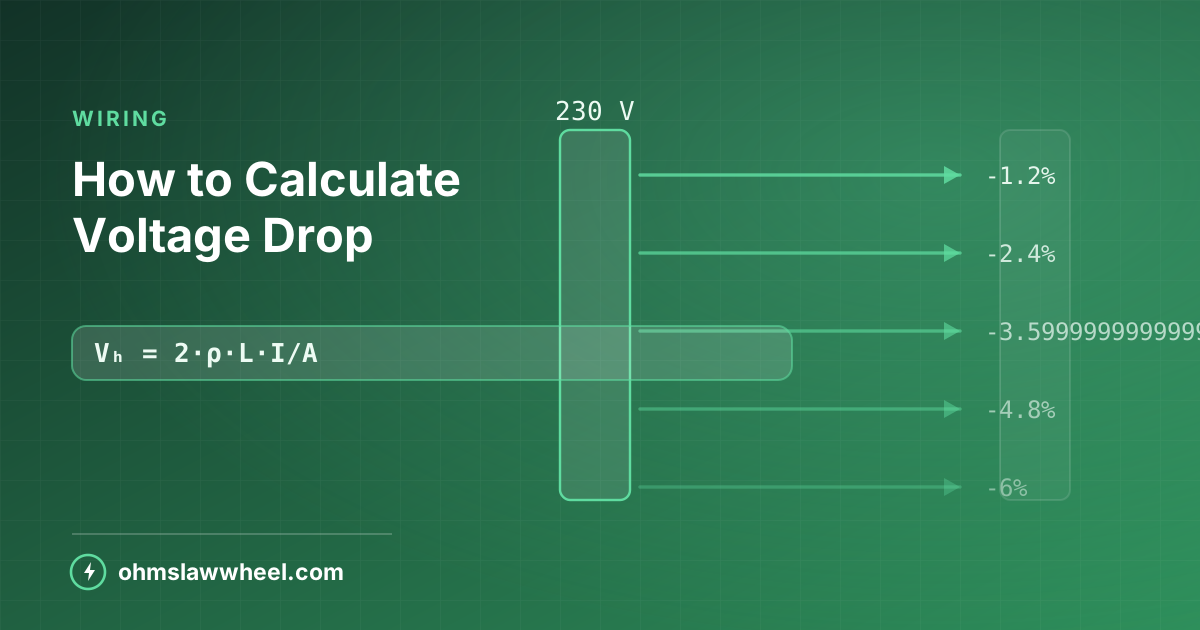
- Vₔₓₒₕ = (2 × ρ × L × I) ÷ A
The factor of 2 accounts for the return conductor. ρ is resistivity in Ω·m, L the one-way length in metres, I the current in amperes and A the cross-section in m².
Three-phase AC
- Vₔₓₒₕ = (√3 × ρ × L × I) ÷ A
Balanced three-phase has no neutral return current, so the multiplier becomes √3 ≈ 1.732 instead of 2 — about 13% less drop for the same load.
Resistivity values at 20 °C
| Material | ρ (Ω·m) | Relative to copper |
|---|---|---|
| Silver | 1.59 × 10⁻⁸ | 0.92 |
| Copper (annealed) | 1.72 × 10⁻⁸ | 1.00 |
| Aluminium | 2.82 × 10⁻⁸ | 1.64 |
| Iron | 9.71 × 10⁻⁸ | 5.65 |
Voltage Drop CalculatorEnter length, current, conductor size and circuit type for the drop in volts, percent and watts lost.
A worked example
A 230 V single-phase circuit feeds a 16 A load 35 m away through 4 mm² copper.
- Conductor length: 2 × 35 = 70 m
- Area in m²: 4 mm² = 4 × 10⁻⁶ m²
- Resistance: (1.72 × 10⁻⁸ × 70) ÷ (4 × 10⁻⁶) = 0.301 Ω
- Drop: 16 × 0.301 = 4.82 V
- Percentage: 4.82 ÷ 230 = 2.1% ✓
- Power lost: 16² × 0.301 = 77 W
Inside the 3% guideline, though 77 W of continuous heat is a real cost over a year — the electricity calculator puts a figure on it.
Acceptable limits
| Circuit | Typical limit | Why |
|---|---|---|
| Lighting final circuit | 3% | Visible dimming and colour shift |
| Power final circuit | 5% | Motor starting torque |
| Supply to final board | 2% | Leaves headroom downstream |
| Low-voltage DC (12 V) | 3% | Only 0.36 V of margin available |
Low-voltage systems are far less forgiving. A 1 V drop is 0.4% of 230 V but 8% of 12 V, which is why solar, automotive and LED-strip wiring so often needs conductors that look oversized.
Reducing the drop
- Increase the cross-section. Drop is inversely proportional to area — doubling it halves the drop. See wire gauge and amp rating.
- Shorten the run. Move the distribution point closer to the load.
- Raise the supply voltage. The same power at twice the voltage halves the current and quarters the loss.
- Split the load. Two circuits each carry half the current.
- Choose copper over aluminium where space is tight — aluminium needs about 64% more area for the same drop.
Temperature matters too
Copper resistance rises about 0.393% per °C. A conductor at 70 °C has roughly 20% more resistance than the 20 °C figure, so a run that calculates at 2.5% cold can reach 3% when fully loaded. Our guide to the resistivity of copper covers the correction.
Measuring drop on an installed circuit
Calculation predicts the drop; measurement confirms it, and finds the faults a calculation cannot.
- Load the circuit to its normal running current — drop only appears when current flows.
- Measure the voltage at the origin, then at the load, without changing the loading.
- The difference is the actual drop across both conductors.
If the measured drop is much larger than calculated, the cable is rarely the problem. Look for a loose terminal, a corroded joint or an undersized connector — a single bad termination can add more resistance than tens of metres of conductor.
Drop across a connection
Measuring directly across a suspect joint while it is loaded is the quickest diagnostic there is. A sound termination shows a few millivolts. Anything approaching a volt is dissipating real power in a small space, and that is how connections overheat.
Check it before you pull cable
The voltage drop calculator at Ohms Law Wheel handles DC, single-phase and three-phase, accepts mm² or AWG, and reports the drop in volts, as a percentage and in watts lost — so you can compare two conductor sizes before committing to either.
Frequently asked questions
What is an acceptable voltage drop?
Around 3% for a lighting final circuit and 5% for power circuits is the common design target, with roughly 2% allowed between the origin and a distribution board. Always confirm against the wiring regulations that apply where you are.
Why do I multiply the cable length by two?
Because current flows out along one conductor and back along the other. A 35 m run means 70 m of conductor in the circuit, so the resistance doubles.
Does voltage drop waste energy?
Yes. The dropped voltage times the current is power dissipated as heat in the cable. A 5 V drop at 16 A wastes 80 W continuously, which is paid for every hour the circuit runs.