Key takeaways
- Two independent checks: ampacity and voltage drop.
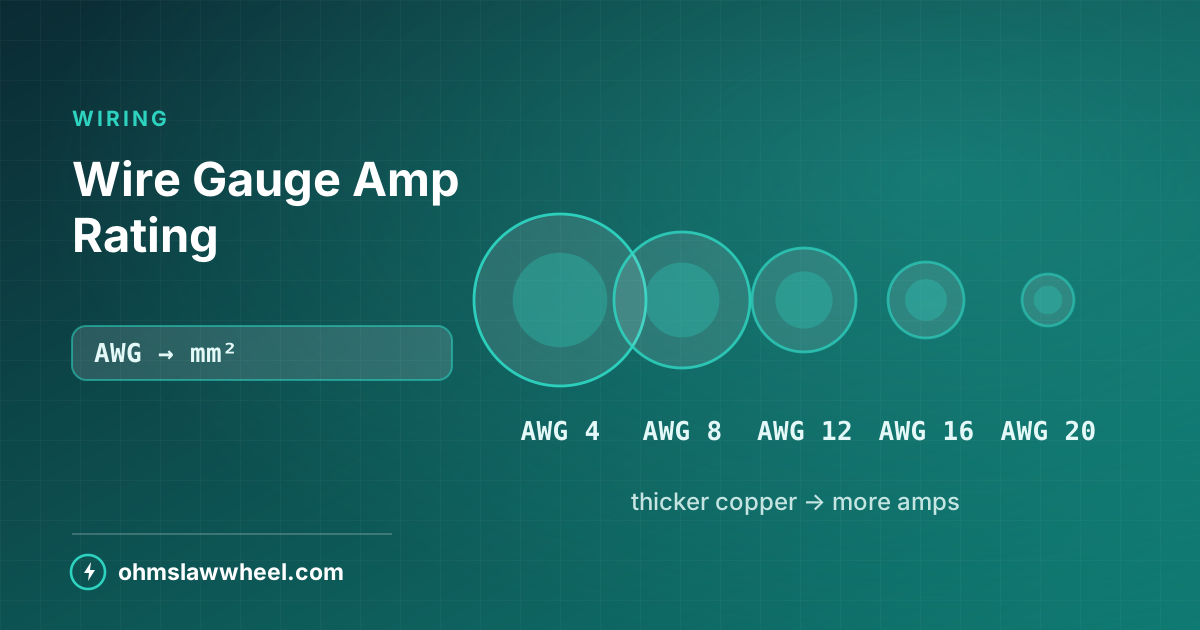
- In AWG, a smaller number means a thicker wire.
- Every 3 AWG steps roughly doubles or halves the cross-section.
- Grouping, insulation and ambient temperature all reduce the usable rating.
How AWG numbering works
American Wire Gauge runs backwards: 10 AWG is thicker than 14 AWG. The scale is logarithmic, and two shortcuts are worth memorising:
- 3 gauges → area changes by about ×2
- 10 gauges → area changes by about ×10
So 10 AWG has roughly ten times the cross-section of 20 AWG, and therefore about a tenth of the resistance per metre.
AWG to mm² and resistance
| AWG | mm² | mΩ per m | Chassis wiring | In conduit |
|---|---|---|---|---|
| 20 | 0.52 | 33.3 | 11 A | 1.5 A |
| 18 | 0.82 | 21.0 | 16 A | 2.3 A |
| 16 | 1.31 | 13.2 | 22 A | 3.7 A |
| 14 | 2.08 | 8.28 | 32 A | 15 A |
| 12 | 3.31 | 5.21 | 41 A | 20 A |
| 10 | 5.26 | 3.28 | 55 A | 30 A |
| 8 | 8.37 | 2.06 | 73 A | 40 A |
| 6 | 13.3 | 1.30 | 101 A | 55 A |
| 4 | 21.2 | 0.815 | 135 A | 70 A |
These figures are indicative for comparison only. Installed ampacity is set by the wiring regulations that apply where you are, and depends on insulation type, installation method, grouping and ambient temperature. Always size from the applicable code.
Conductor Resistance CalculatorGet the resistance of any length and cross-section, in copper, aluminium or other conductors.
The two checks
Check 1 — ampacity
Will the conductor carry the current without exceeding its insulation temperature? This is a thermal question, and it is independent of length. Start from the table, then apply derating factors:
- Grouping. Several cables bundled together cannot shed heat individually.
- Ambient temperature. A hot roof space can cut capacity by a third.
- Insulation. A 90 °C rated insulation allows more current than a 70 °C one.
- Enclosure. Conduit and trunking restrict airflow.
Check 2 — voltage drop
Will enough voltage arrive at the far end? This is length dependent, and on long runs it usually forces a larger conductor than ampacity alone would need.
Worked comparison
A 12 V DC circuit drawing 15 A over 8 m one-way:
| Size | Loop resistance | Drop | % of 12 V | Verdict |
|---|---|---|---|---|
| 14 AWG | 0.132 Ω | 1.99 V | 16.6% | Fails badly |
| 10 AWG | 0.052 Ω | 0.79 V | 6.6% | Still too much |
| 6 AWG | 0.021 Ω | 0.31 V | 2.6% | Acceptable |
14 AWG passes the ampacity check for 15 A in free air, yet loses a sixth of the supply. At 12 V, voltage drop decides — see how to calculate voltage drop for the method.
A sizing routine
- Find the load current. From the nameplate, or with I = P ÷ V — see watts to amps.
- Add headroom. Design for the protective device rating, not just the running current.
- Pick a size on ampacity, then apply the derating factors.
- Test the voltage drop at the real run length.
- Take the larger of the two answers.
Aluminium and stranding
- Aluminium has about 1.64 times the resistivity of copper, so it needs roughly two AWG sizes larger for the same performance.
- Stranded conductors carry the same current as solid ones of equal cross-section; the difference is flexibility, not ampacity.
- Aluminium terminations need connectors rated for it, and correct torque — a common cause of overheated joints.
Protection and conductor size
The conductor and its protective device are chosen together, because the breaker or fuse exists to stop the cable exceeding its safe temperature.
- The device rating must be at or below the cable's derated ampacity.
- It must also be at or above the design current of the load.
- If no standard device fits between those two figures, the cable is too small.
Fitting a larger breaker to stop nuisance tripping without changing the cable removes the protection the cable depends on — the fault it was sized to prevent is the one that then goes uninterrupted.
Practical points on terminations
- A conductor is only as good as its joint; torque terminals to the stated figure.
- Do not mix copper and aluminium in a connector unless it is rated for both.
- Ferrules on stranded conductors prevent strands escaping and reduce contact resistance.
Check the numbers
The conductor resistance calculator at Ohms Law Wheel converts between AWG and mm² and reports resistance for the material and length you specify, so both checks come from the same set of figures.
Frequently asked questions
What size wire do I need for 20 amps?
For a typical copper circuit in conduit, 12 AWG (about 3.3 mm²) is the usual choice for 20 A. On a long run the voltage drop check may force a larger size, and the applicable wiring regulations always take precedence.
Why is a smaller AWG number a thicker wire?
The gauge originally counted drawing operations — each pass through a die made the wire thinner and raised the number. A 4 AWG conductor has been drawn fewer times than a 14 AWG one.
Does wire length affect the gauge I need?
It does not change ampacity, but it changes voltage drop, which is proportional to length. On long runs the drop calculation usually decides the conductor size.