Key takeaways
- DC or resistive AC: I = P ÷ V.
- Reactive AC loads: divide by power factor as well.
- Three-phase: divide by √3 × line voltage × power factor.
- Always use the RMS voltage on AC.
The basic conversion
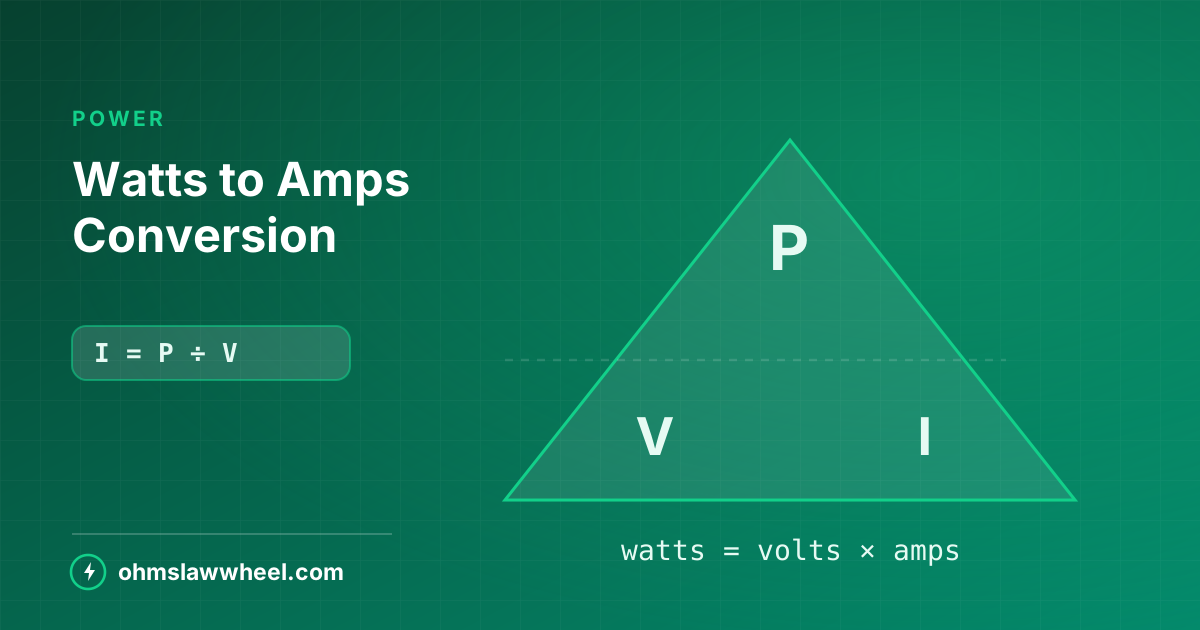
Power is voltage times current, so rearranging gives:
- I = P ÷ V
A 1200 W appliance on 230 V draws 1200 ÷ 230 = 5.22 A. On a 120 V supply the same appliance draws 10 A — the reason North American circuits need heavier conductors for the same load.
Quick reference
| Power | at 12 V | at 120 V | at 230 V |
|---|---|---|---|
| 10 W | 0.83 A | 0.08 A | 0.04 A |
| 60 W | 5.00 A | 0.50 A | 0.26 A |
| 100 W | 8.33 A | 0.83 A | 0.43 A |
| 500 W | 41.7 A | 4.17 A | 2.17 A |
| 1000 W | 83.3 A | 8.33 A | 4.35 A |
| 2000 W | 167 A | 16.7 A | 8.70 A |
| 3000 W | 250 A | 25.0 A | 13.0 A |
The 12 V column shows why low-voltage systems need such heavy cable — and why voltage drop dominates their design.
Electricity CalculatorTurn an appliance wattage into current, daily energy and running cost in one step.
Correction 1 — power factor
On AC, a reactive load draws current that is out of step with the voltage. Some of that current does no useful work but still flows in the cable.
- I = P ÷ (V × PF)
| Load | Power factor | Current for 1 kW at 230 V |
|---|---|---|
| Heater, kettle, filament lamp | 1.00 | 4.35 A |
| Modern PSU with correction | 0.95 | 4.58 A |
| Induction motor, loaded | 0.85 | 5.12 A |
| Induction motor, lightly loaded | 0.60 | 7.25 A |
| Older fluorescent ballast | 0.50 | 8.70 A |
The cable, breaker and switch must handle the actual current, not the current implied by the wattage. A 1 kW motor at 0.6 power factor loads the circuit like a 1.45 kW heater.
Correction 2 — three-phase
For a balanced three-phase load using the line-to-line voltage:
- I = P ÷ (√3 × Vₗₙₘₑ × PF)
Worked example
An 11 kW motor on a 400 V three-phase supply at 0.86 power factor:
- Denominator: 1.732 × 400 × 0.86 = 595.8
- I = 11000 ÷ 595.8 = 18.5 A per line
The same 11 kW on single-phase 230 V at the same power factor would be 55.6 A — three times the conductor requirement, which is why larger machines are three-phase.
Motor nameplates
A motor's kW rating is its mechanical output. Input power is higher by the efficiency factor, so a 3 kW motor at 88% efficiency draws 3.41 kW electrically. Size cable and protection from the nameplate current, not the kW figure.
Going the other way
- P = V × I — DC or resistive AC
- P = V × I × PF — single-phase reactive
- P = √3 × V × I × PF — three-phase
Sizing a supply from a load list
The conversion is most useful when applied to a whole system rather than one appliance. The method is the same each time.
- List every load with its wattage and the voltage it runs at.
- Convert each to current at that voltage.
- Add the currents that share a rail — never add currents at different voltages.
- Add headroom, typically 20-25%, for inrush and future additions.
Inrush
| Load | Inrush multiple |
|---|---|
| Resistive heater | ×1 |
| Filament lamp | ×8 - 12 |
| Switch-mode supply | ×5 - 20 |
| Induction motor | ×6 - 8 |
Inrush lasts only milliseconds, so it rarely affects cable sizing, but it very much affects the choice of protective device curve.
What to do with the answer
Once you have the current, it feeds directly into conductor selection and protection sizing. Take it to wire gauge amp rating for the cable, and to the V-I-R-P solver if you also need the equivalent resistance or a cross-check on the power.
Frequently asked questions
How do I convert watts to amps?
Divide watts by volts. For AC with a reactive load, divide by voltage times power factor. For balanced three-phase, divide by √3 times the line voltage times power factor.
How many amps is 1000 watts?
About 4.35 A on a 230 V supply, 8.33 A on 120 V, or 83.3 A on 12 V — assuming a resistive load with a power factor of 1.0.
Do I need power factor for a heater?
No. Heaters, kettles and filament lamps are essentially resistive, so their power factor is 1.0 and the simple division applies.