Key takeaways
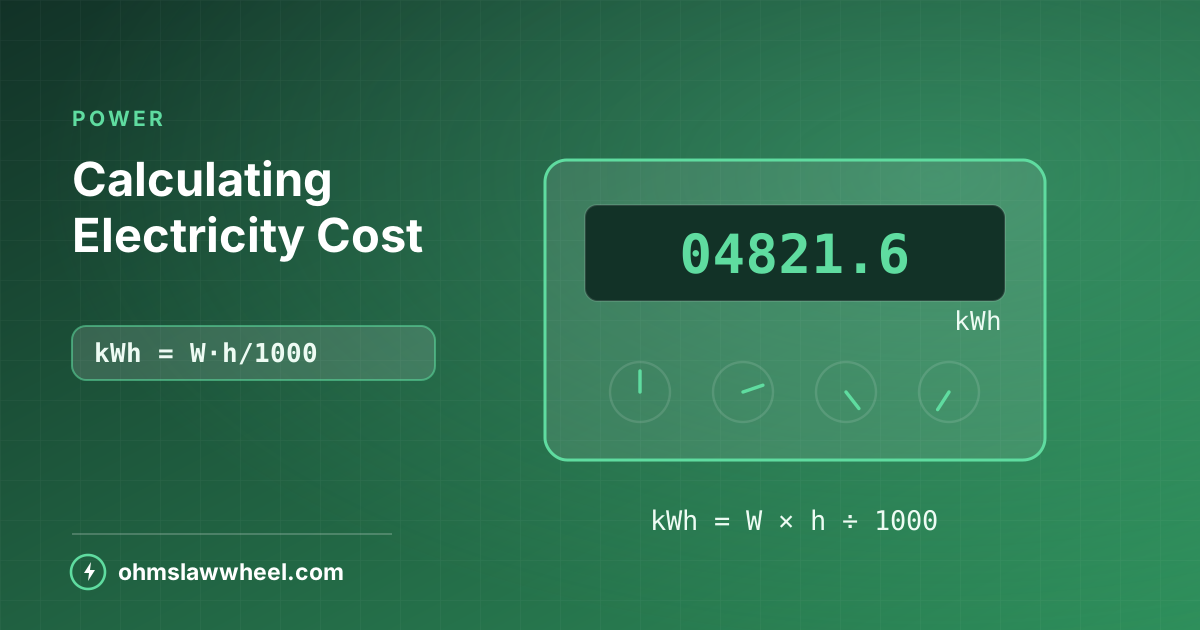
- kWh = watts × hours ÷ 1000
- cost = kWh × unit rate
- Power is a rate; energy is power × time. You are billed for energy.
- Small constant loads often cost more per year than large occasional ones.
Power versus energy
A 2000 W heater and a 5 W router draw very different power, but the router runs 8760 hours a year and the heater perhaps 300. Energy, not power, is what appears on the bill.
- Power — watts, the instantaneous rate.
- Energy — kilowatt-hours, power sustained over time.
One kilowatt-hour is one kilowatt for one hour, or 3.6 megajoules.
The calculation, step by step
- Find the wattage. Check the rating plate, or measure it. If only current is given, use P = V × I.
- Estimate hours per day. Be honest — a fridge cycles roughly 8 hours of compressor time per day, not 24.
- Convert to kWh: watts × hours ÷ 1000.
- Multiply by your rate, taken from the bill, not from memory.
Worked example
A 1500 W air conditioner, 6 hours a day, 30 days, at 0.24 per kWh:
- Daily: 1500 × 6 ÷ 1000 = 9 kWh
- Monthly: 9 × 30 = 270 kWh
- Cost: 270 × 0.24 = 64.80
Electricity Cost CalculatorEnter wattage, hours per day, days and your rate for daily, monthly and annual cost.
Typical appliance costs
| Appliance | Watts | Hours/day | kWh/month | Cost |
|---|---|---|---|---|
| LED bulb | 9 | 5 | 1.35 | 0.34 |
| Wi-Fi router | 8 | 24 | 5.76 | 1.44 |
| Laptop | 60 | 8 | 14.4 | 3.60 |
| Refrigerator | 150 | 8 | 36.0 | 9.00 |
| Washing machine | 700 | 1 | 21.0 | 5.25 |
| Electric kettle | 2200 | 0.3 | 19.8 | 4.95 |
| Air conditioner | 1500 | 6 | 270 | 67.50 |
| Electric heater | 2000 | 4 | 240 | 60.00 |
The router uses less than a fortieth of the air conditioner's energy, despite running continuously. Heating and cooling dominate almost every bill.
Standby loads
Devices left on standby draw a small but constant load. Ten devices at 3 W each is 30 W continuous:
- 30 × 24 × 365 ÷ 1000 = 263 kWh per year
- At 0.25 per kWh, that is 65.70 annually for nothing at all
Reading your own meter
- Note the meter reading, wait a measured interval, read again. The difference is kWh used.
- To isolate one appliance, switch everything else off — or use a plug-in energy monitor.
- Watch for a two-rate meter with separate day and night registers.
- Compare your calculated total against the bill; a large gap usually points at a missed continuous load.
Bills often include a fixed daily standing charge plus taxes on top of the unit rate. The calculation above gives the energy cost; your final bill will be higher by those fixed elements.
Finding an appliance wattage you do not have
Rating plates are often missing, unreadable, or quote a maximum the appliance never actually reaches. Three approaches usually get you a workable figure.
- Read the current instead. If the plate lists amps, multiply by the supply voltage to get watts.
- Use a plug-in energy monitor. The most reliable option for anything that cycles, because it records real consumption over time rather than a peak.
- Measure at the meter. Switch everything else off and time how long the meter takes to advance one unit.
Cycling loads
A fridge, a thermostatic heater and an air conditioner all switch on and off. Their plate wattage is what they draw while running, not an average. Estimating the duty cycle — the fraction of time they are actually on — is what turns that plate figure into a realistic daily energy number, and it is where most household estimates go wrong.
Where the losses hide
Not every watt reaches the load. Cable resistance turns some of it into heat before it arrives — a 77 W loss in a cable run costs about 169 per year at 0.25 per kWh if it runs continuously. Our voltage drop guide shows how to calculate that, and watts to amps converts a rating into the current that causes it.
The electricity calculator at Ohms Law Wheel does the arithmetic for any appliance, quantity and rate, in your own currency.
Frequently asked questions
How do I calculate the cost of running an appliance?
Multiply its wattage by the hours it runs, divide by 1000 to get kilowatt-hours, then multiply by your unit rate. A 1500 W heater for 4 hours uses 6 kWh.
How much does it cost to leave something on standby?
A 3 W standby load uses about 26 kWh a year. Ten such devices come to roughly 263 kWh annually — a real cost for no benefit.
Why is my bill higher than my calculation?
Most bills add a fixed daily standing charge and taxes to the unit rate. Continuous loads such as fridges, routers and standby power are also easy to overlook.