Key takeaways
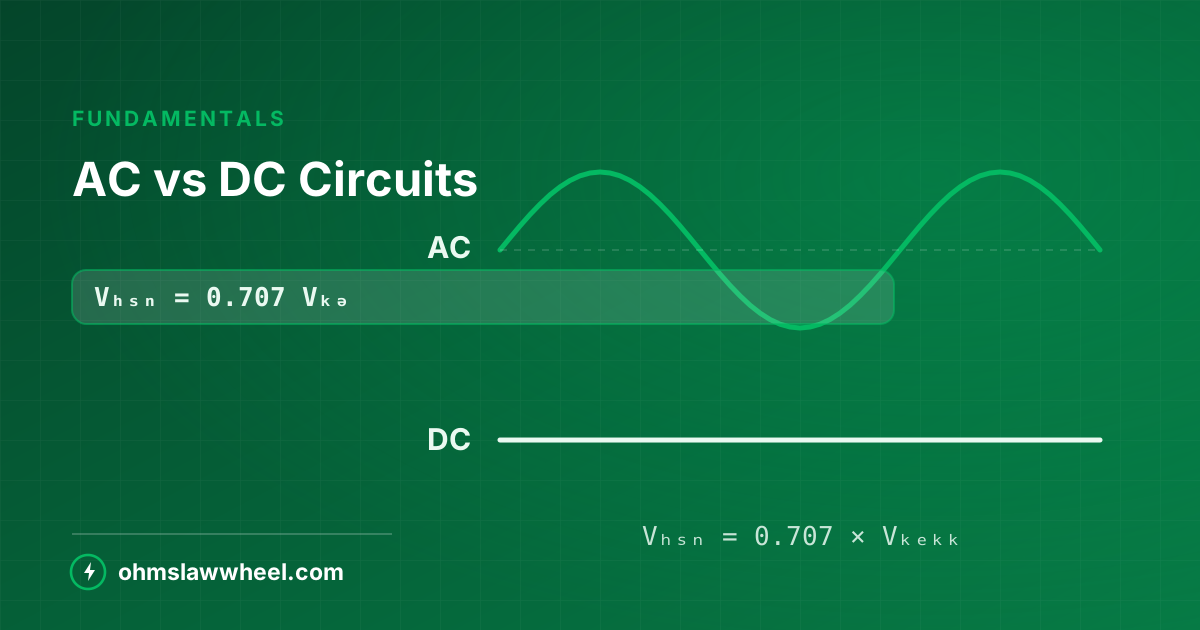
- DC holds one polarity; AC reverses direction cyclically, 50 or 60 times a second.
- Mains voltages are quoted as RMS, not peak.
- Ohm's law works on AC with RMS values — provided the load is resistive.
- Reactive loads need impedance (Z) and power factor.
What actually differs
| Property | DC | AC |
|---|---|---|
| Direction | Constant | Reverses each half cycle |
| Typical source | Battery, PSU, solar panel | Grid, alternator |
| Opposition | Resistance (R) | Impedance (Z) |
| Quoted voltage | Actual value | RMS value |
| Transforms easily? | No | Yes |
| Common use | Electronics, EV batteries | Transmission, domestic supply |
RMS, peak and why it matters
A 230 V AC supply does not sit at 230 V. It swings between about +325 V and −325 V. The quoted figure is the root mean square value — the DC voltage that would produce the same heating in a resistor.
- Vₕₛₙ = Vₖₔₖₖ × 0.7071
- Vₖₔₖₖ = Vₕₛₙ × 1.4142
| Region | RMS | Peak | Frequency |
|---|---|---|---|
| UK / EU | 230 V | 325 V | 50 Hz |
| North America | 120 V | 170 V | 60 Hz |
| Japan (east) | 100 V | 141 V | 50 Hz |
Insulation and capacitor voltage ratings must clear the peak, not the RMS figure. A part rated 250 V is not adequate for a 230 V mains supply that peaks at 325 V.
Electricity Cost CalculatorWork out running cost from an appliance rating, whether it runs on mains AC or a DC supply.
Does ohms law work on AC?
Yes, with two conditions. Use RMS values throughout, and make sure the load is resistive. For a heater, kettle or filament lamp, the ohms law wheel chart applies unchanged.
When the load is reactive
Motors, transformers and fluorescent ballasts store and return energy each cycle. Resistance becomes impedance:
- V = I × Z
- P = V × I × cosφ — where cosφ is the power factor
A motor drawing 5 A at 230 V with a power factor of 0.8 consumes 920 W, not 1150 W. The difference is reactive power, which circulates without doing work but still heats the cable.
What stays the same
- Kirchhoff's laws. Both laws hold for AC at every instant.
- Series and parallel rules. Resistances still add in series.
- Voltage drop in cables. Conductor resistance behaves the same; our voltage drop calculator handles DC, single-phase and three-phase.
- Energy billing. kWh is kWh, whichever the supply.
Frequency and what it changes
Beyond direction, the other property DC does not have is frequency — and several practical effects follow from it.
- Transformers work. A changing magnetic field induces voltage in a second winding, which is the whole basis of grid distribution.
- Reactance appears. Capacitors pass AC more easily as frequency rises; inductors resist it more.
- Skin effect emerges. At high frequency, current crowds toward the conductor surface, raising effective resistance. At 50 or 60 Hz it is negligible for ordinary cable sizes.
- Switching becomes easier. Because AC crosses zero twice per cycle, a breaker interrupting it has a natural moment to extinguish the arc — one reason DC breakers of the same rating are physically larger.
Converting between the two
A rectifier turns AC into pulsating DC, and a smoothing capacitor flattens it. An inverter does the reverse. Almost every mains-powered device you own contains the first pair, which is why the supply arriving at a circuit board is DC even though the wall socket is not.
Choosing between them
AC won the distribution argument because transformers make it cheap to step voltage up for transmission and back down for use. DC dominates inside equipment, where semiconductors need a steady rail. Most modern devices use both: AC in at the wall, rectified to DC on the board.
Whichever side of the converter you are working on, the calculators at Ohms Law Wheel take the values you actually measure — just be clear whether they are RMS or DC before you type them in.
Frequently asked questions
Can I use ohms law on AC circuits?
Yes, for resistive loads using RMS voltage and current. For motors, transformers and other reactive loads, replace resistance with impedance and include power factor.
Why is mains voltage quoted as RMS?
Because RMS is the DC-equivalent value for heating. A 230 V RMS supply heats a resistor exactly as a 230 V DC supply would, even though it peaks at 325 V.
Is DC more dangerous than AC?
Both are dangerous at mains levels. AC at 50-60 Hz is more likely to cause cardiac fibrillation at a given current, while DC tends to cause sustained muscle contraction. Treat either with equal caution.