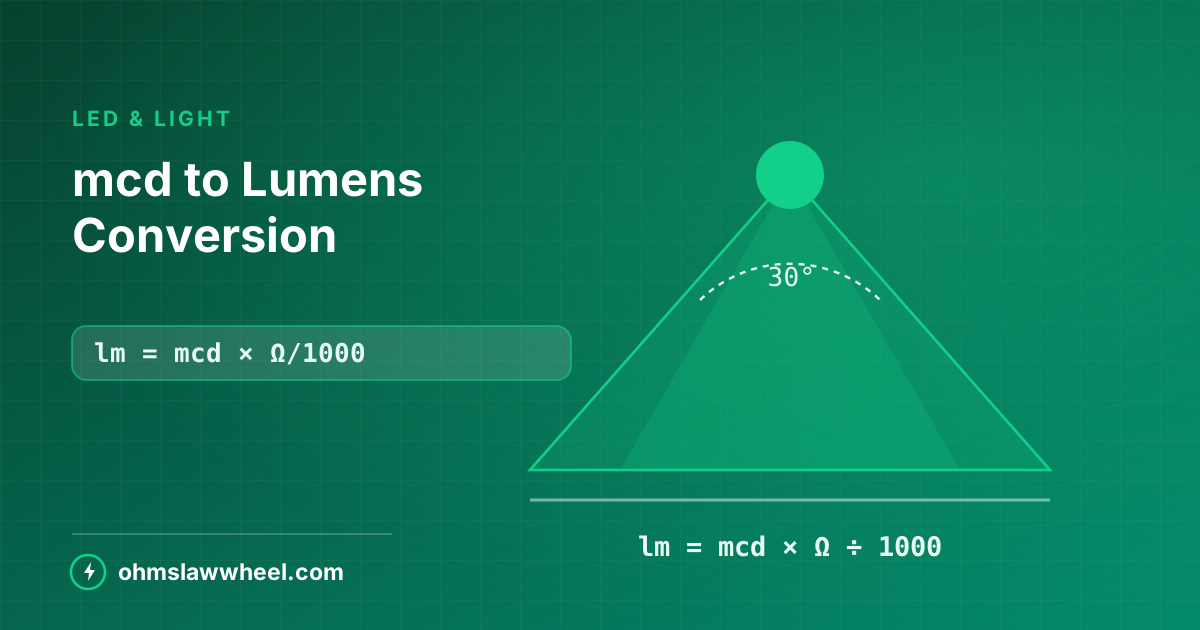
Key takeaways
- Candela is intensity per unit solid angle; lumens are total flux.
- You cannot convert without the beam angle.
- A narrow beam gives a high mcd figure from very little total light.
What each unit measures
| Unit | Symbol | Measures | Depends on beam angle? |
|---|---|---|---|
| Candela | cd | Intensity in one direction | Yes |
| Millicandela | mcd | Thousandth of a candela | Yes |
| Lumen | lm | Total light emitted | No |
| Lux | lx | Lumens landing per m² | Via distance |
| Steradian | sr | Solid angle | — |
The key relationship: one candela is one lumen per steradian. Concentrate the same lumens into a narrower cone and the candela figure rises without a single extra photon being produced.
The conversion formula
Two steps. First, turn the beam angle into a solid angle:
- Ω = 2π × (1 − cos(θ ÷ 2))
Then multiply by intensity:
- lumens = (mcd ÷ 1000) × Ω
θ is the full apex angle of the cone, which is why it is halved inside the cosine.
Solid angle reference
| Beam angle | Solid angle (sr) | Typical device |
|---|---|---|
| 10° | 0.0239 | Narrow indicator LED |
| 15° | 0.0538 | Clear 5 mm LED |
| 30° | 0.2144 | Standard 5 mm LED |
| 60° | 0.8418 | Diffused LED |
| 120° | 3.1416 | Surface-mount LED |
| 180° | 6.2832 | Hemispherical |
| 360° | 12.566 | Bare filament |
mcd to Lumens ConverterEnter the millicandela rating and beam angle to get lumens, with the solid angle shown.
Worked examples
Example 1 — a narrow indicator
8000 mcd, 15° beam:
- Ω = 0.0538 sr
- lm = 8 × 0.0538 = 0.43 lm
An impressive-looking mcd number, but under half a lumen in total.
Example 2 — a wide diffused LED
800 mcd, 120° beam:
- Ω = 3.1416 sr
- lm = 0.8 × 3.1416 = 2.51 lm
A tenth of the intensity but nearly six times the total light. This is why comparing LEDs on mcd alone is misleading.
Beam angle is normally quoted as the angle at which intensity falls to half its on-axis peak. Real LEDs do not have a hard cone edge, so treat any conversion as a good estimate rather than a measurement.
Reading a datasheet honestly
- Check the test current. An mcd figure at 20 mA means nothing if you drive the LED at 5 mA.
- Look for lumens directly. Power LED datasheets usually quote flux, removing the guesswork.
- Compare like with like. Two LEDs are only comparable on mcd if their beam angles match.
- Watch for peak values. Some marketing figures quote pulsed peaks, not continuous output.
Lux, distance and the inverse square law
Intensity in candela also tells you the illuminance a source produces at a distance, which is often the number that actually matters.
- lux = candela ÷ distance²
A 5000 mcd LED is 5 cd, so at 0.5 m it produces 5 ÷ 0.25 = 20 lux, and at 2 m only 1.25 lux. Doubling the distance quarters the illuminance.
| Setting | Typical lux |
|---|---|
| Full daylight | 10000+ |
| Office lighting | 300 - 500 |
| Corridor | 100 |
| Twilight | 10 |
This is why an indicator that looks blinding on the bench can be invisible across a room, and why status LEDs are specified by the viewing angle they must remain readable within.
Where this matters in a design
If you are lighting a panel, total lumens is the number that counts and a wide beam is what you want. If you are signalling at distance or triggering a sensor, intensity along the axis matters and a narrow beam wins.
Either way, the electrical side is unchanged: the LED still needs its current set. Pair this with the LED series resistor guide and check both halves with the converter and the LED resistor calculator at Ohms Law Wheel.
Frequently asked questions
How do I convert mcd to lumens?
Convert the beam angle to a solid angle with Ω = 2π(1 − cos(θ/2)), then multiply by the intensity in candela: lumens = (mcd ÷ 1000) × Ω.
Why do I need the beam angle to convert mcd to lumens?
Because candela measures light per unit solid angle. The same total lumens squeezed into a narrower cone gives a much higher candela reading, so the angle is essential.
Is a higher mcd rating always brighter?
Only along the axis. A 10000 mcd LED with a 10° beam emits far less total light than a 500 mcd LED spread over 120°.