Key takeaways
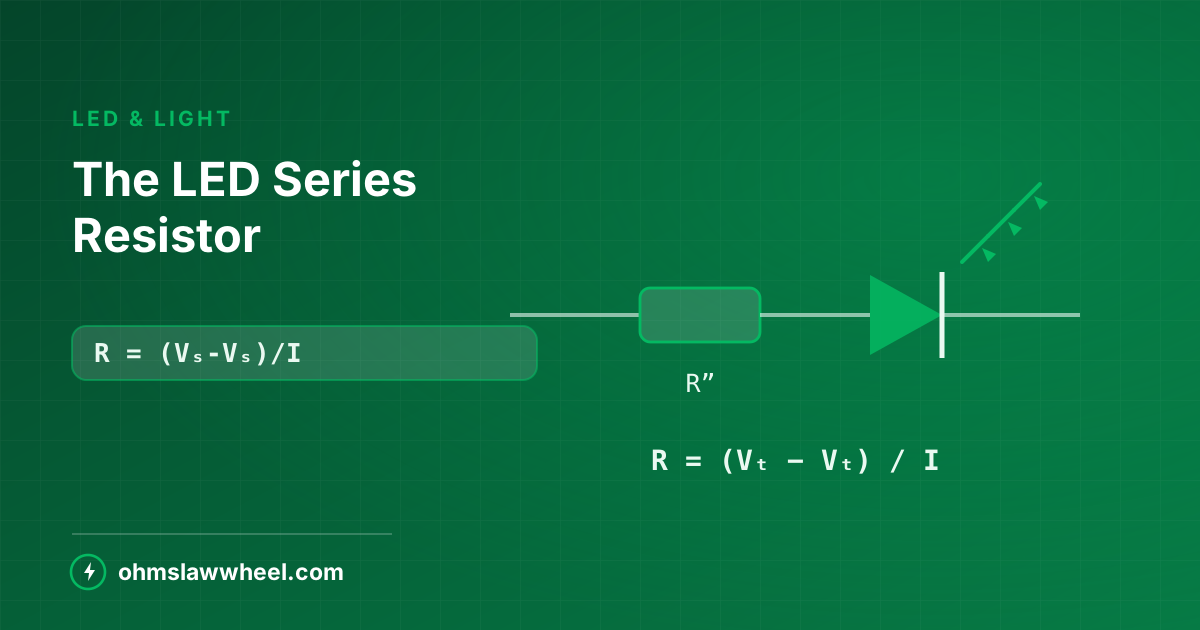
- R = (VₛₙₖₖₗΩ − Vₘ) ÷ I
- Always round the resistor up to the next standard value.
- LEDs in parallel need one resistor each.
- Check the resistor's dissipation, not just its resistance.
Why an LED needs a resistor at all
An LED is a diode. Above its forward voltage the current rises almost vertically with voltage — a few tenths of a volt more can double the current. Connect one straight across a supply and it draws whatever the supply can deliver, then fails.
A series resistor makes the current predictable: it absorbs the difference between the supply and the LED's forward voltage, and Ohm's law fixes the rest.
The calculation
- R = (VₛₙₖₖₗΩ − Vₘ) ÷ I
Worked example
A red LED (Vₘ = 2.0 V) at 15 mA from a 5 V rail:
- Voltage across the resistor: 5 − 2.0 = 3.0 V
- R = 3.0 ÷ 0.015 = 200 Ω
- Nearest standard value up: 220 Ω → actual current 13.6 mA
- Dissipation: 0.0136² × 220 = 41 mW — a 1/8 W part is fine
Round up, never down. A higher resistance lowers the current, which is the safe direction. Rounding down pushes the LED past its rating.
Typical forward voltages
| Colour | Typical Vₘ | Range | R for 5 V @ 15 mA |
|---|---|---|---|
| Infrared | 1.4 V | 1.2 - 1.6 | 240 Ω |
| Red | 2.0 V | 1.8 - 2.2 | 200 Ω |
| Amber / yellow | 2.1 V | 2.0 - 2.4 | 193 Ω |
| Green | 3.0 V | 2.0 - 3.4 | 133 Ω |
| Blue | 3.2 V | 3.0 - 3.6 | 120 Ω |
| White | 3.2 V | 2.9 - 3.6 | 120 Ω |
LED Resistor CalculatorEnter supply, forward voltage and target current for the resistor value, the nearest standard part and its power rating.
Multiple LEDs
In series — one resistor for the string
Forward voltages add. Three white LEDs at 3.2 V need 9.6 V, so a 12 V supply leaves 2.4 V for the resistor. At 20 mA that is 120 Ω.
- Efficient — one resistor, one current.
- Needs enough supply headroom; leave at least 15-20% for the resistor or the current becomes very sensitive to Vₘ spread.
- One failure opens the whole string.
In parallel — one resistor each
Never put several LEDs in parallel behind a single resistor. Small differences in forward voltage mean the lowest-Vₘ device takes most of the current, runs hottest, and drops further — a thermal runaway that ends with one dead LED and the rest dim.
Give every parallel branch its own resistor. The LED resistor calculator handles series-parallel arrays and reports the total supply current.
Choosing the current
| Current | Result | Use for |
|---|---|---|
| 1 - 3 mA | Dim but visible | Modern high-efficiency indicators |
| 5 - 10 mA | Comfortable indoors | Panel indicators |
| 15 - 20 mA | Full brightness | Standard 5 mm LEDs |
| > 20 mA | Check the datasheet | Power LEDs only, usually driven by a constant-current source |
Driving LEDs from a microcontroller
- Check the per-pin current limit — often 20 mA, with a lower total across the port.
- Use 5-10 mA per indicator to stay well inside it.
- For anything brighter, switch the LED with a transistor and feed it from the supply rail.
- The resistor still belongs in series with the LED, whichever side of it the switch sits.
Supply voltage and current stability
How much voltage the resistor drops decides how stable the current is. The larger that share, the less a change in forward voltage matters.
| Supply | V across R | Current change |
|---|---|---|
| 3.3 V | 0.1 V | ±200% |
| 5 V | 1.8 V | ±11% |
| 12 V | 8.8 V | ±2.3% |
| 24 V | 20.8 V | ±1% |
Driving a 3.2 V white LED from a 3.3 V rail through a resistor is close to unworkable, because the resistor has almost no voltage to work with and every device varies. Either raise the supply or use a constant-current driver.
Efficiency
The resistor wastes whatever it drops. On 12 V driving one 2 V LED, 83% of the energy becomes heat in the resistor. Putting several LEDs in series recovers most of that, which is why LED strips group three at a time for a 12 V supply.
When a resistor is not enough
Above roughly 100 mA, a resistor wastes too much power and cannot hold current steady as the LED heats. Power LEDs need a constant-current driver. For output comparisons in that territory, our mcd to lumens conversion guide explains what the brightness figures actually mean.
Frequently asked questions
What resistor do I need for an LED on 5V?
For a red LED at 15 mA, about 200 Ω — use the next standard value up, 220 Ω. For a blue or white LED at the same current, about 120 Ω. Always calculate from the actual forward voltage.
Can two LEDs share one resistor?
In series, yes — they carry the same current. In parallel, no. Forward voltage differences make one LED hog the current, so each parallel branch needs its own resistor.
What happens if the LED resistor is too large?
Nothing dangerous. The LED simply runs dimmer because the current is lower. Too small a resistor is the risk — it overdrives the LED and shortens its life sharply.