Key takeaways
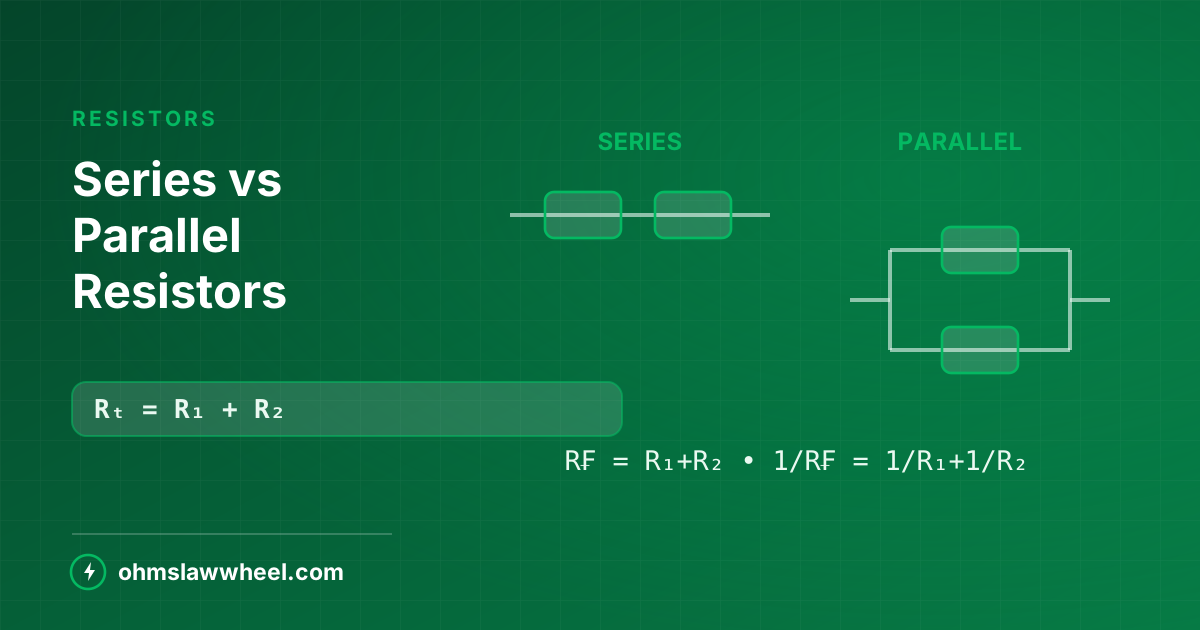
- Series: resistances add; the total is larger than the largest.
- Parallel: reciprocals add; the total is smaller than the smallest.
- Series components share the same current; parallel branches share the same voltage.
Resistors in series
End to end, with one path for current:
- Rₜₒₜₑ₣ = R₁ + R₂ + R₃ + …
Every resistor carries the identical current, and the supply voltage divides between them in proportion to their resistance — the basis of the voltage divider rule.
Series example
100 Ω + 220 Ω + 470 Ω across 12 V:
- Total: 790 Ω
- Current: 12 ÷ 790 = 15.2 mA (through all three)
- Drops: 1.52 V, 3.34 V and 7.14 V — summing to 12 V
Resistors in parallel
Side by side across the same two nodes:
- 1 ÷ Rₜₒₜₑ₣ = 1/R₁ + 1/R₂ + 1/R₃ + …
The two-resistor shortcut
For exactly two resistors, the product-over-sum form is quicker:
- R = (R₁ × R₂) ÷ (R₁ + R₂)
It only works for two at a time — for three or more, use the reciprocal form or combine in pairs.
Parallel example
220 Ω and 470 Ω across 12 V:
- Equivalent: (220 × 470) ÷ 690 = 149.9 Ω
- Branch currents: 54.5 mA and 25.5 mA
- Total: 80.0 mA — matching 12 ÷ 149.9 ✓
Parallel Resistor CalculatorAdd as many branches as you need and get the equivalent resistance plus each branch current.
Side-by-side comparison
| Property | Series | Parallel |
|---|---|---|
| Total resistance | Sum of all | Less than smallest |
| Current | Same in every part | Divides between branches |
| Voltage | Divides across parts | Same across every branch |
| One part fails open | Whole circuit stops | Other branches keep working |
| Adding a resistor | Raises total R | Lowers total R |
| Typical use | Current limiting, dividers | Load sharing, raising power rating |
Reducing a mixed network
Work from the innermost combination outwards. Take 100 Ω in series with a parallel pair of 300 Ω and 600 Ω, all across 9 V.
- Parallel pair: (300 × 600) ÷ 900 = 200 Ω
- Add the series part: 100 + 200 = 300 Ω
- Total current: 9 ÷ 300 = 30 mA
- Split it back: 6 V across the pair → 20 mA and 10 mA
The two branch currents sum to 30 mA, confirming Kirchhoff's current law.
Sanity checks worth memorising
- A parallel total larger than the smallest branch means an arithmetic slip.
- Two equal resistors in parallel give exactly half their value.
- N identical resistors in parallel give R ÷ N.
- A very large resistor in parallel with a small one barely changes the small one.
Parallel resistors also share heat. Two 1 kΩ half-watt parts in parallel give 500 Ω with a 1 W capability — a common way to reach an unavailable rating. See resistor power rating.
Where each arrangement is used deliberately
Series and parallel are not just descriptions of a circuit — they are design choices made for specific reasons.
Reasons to choose series
- Current limiting. A single resistor in the path sets the current for an LED or a sensor.
- Voltage division. Two resistors create a reference from a higher rail.
- Sharing voltage stress. Two parts each see half the voltage, which matters when working near a component's rating.
Reasons to choose parallel
- Sharing current and heat. Two parts each carry half, doubling the effective power rating.
- Redundancy. One open branch leaves the others working.
- Reaching an unavailable value. Two preferred values in parallel can land on a resistance that is not stocked.
The decision is rarely about the total resistance alone; it is usually about where the voltage, the current and the heat need to go.
Check your working
The series and parallel calculators at Ohms Law Wheel take any number of values and show the equivalent resistance, so you can reduce a network stage by stage and verify each step.
Frequently asked questions
Do resistors in parallel always give a smaller total?
Yes. Adding a parallel path gives current somewhere else to go, so the equivalent resistance is always lower than the smallest single branch.
Can I use the product-over-sum formula for three resistors?
Not in one step. Combine two, then apply it again to that result and the third. The reciprocal formula handles any number at once.
Why does one blown resistor stop a whole series circuit?
Because a series circuit has a single path. An open anywhere breaks the loop, so no current flows through any part of it.