Key takeaways
- Read from the end with bands closest to the lead.
- The tolerance band (gold or silver) is the widely spaced one — keep it on the right.
- First bands are digits, the next is a multiplier, the last is tolerance.
The full colour chart
| Colour | Digit | Multiplier | Tolerance | ppm/°C |
|---|---|---|---|---|
| Black | 0 | ×1 | — | — |
| Brown | 1 | ×10 | ±1% | 100 |
| Red | 2 | ×100 | ±2% | 50 |
| Orange | 3 | ×1 k | — | 15 |
| Yellow | 4 | ×10 k | — | 25 |
| Green | 5 | ×100 k | ±0.5% | — |
| Blue | 6 | ×1 M | ±0.25% | 10 |
| Violet | 7 | ×10 M | ±0.1% | 5 |
| Grey | 8 | — | ±0.05% | 1 |
| White | 9 | — | — | — |
| Gold | — | ×0.1 | ±5% | — |
| Silver | — | ×0.01 | ±10% | — |
Which end do you start from?
Three reliable tells, in order of usefulness:
- The gap. A wider space sits before the tolerance band. Put that band on the right.
- Gold or silver. Almost always tolerance, and almost always last.
- Band spacing. The digit bands are grouped closer to one lead.
If it is still ambiguous, read it both ways. One direction usually gives an absurd value like 0.47 Ω where 47 kΩ makes sense — the E-series preferred values settle it.
Resistor Color Code CalculatorPick the bands from a drop-down and read the value, tolerance and preferred-series match instantly.
Four-band resistors
Two digits, one multiplier, one tolerance. This is the standard ±5% part.
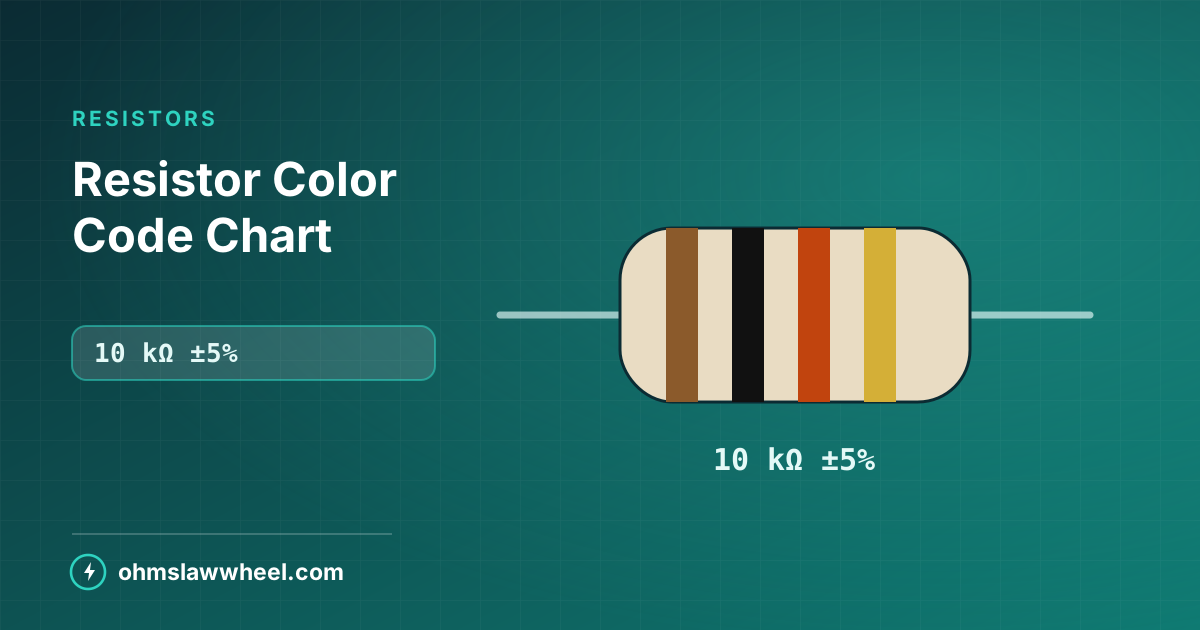
Example: brown – black – orange – gold
- Brown = 1, Black = 0 → digits 10
- Orange = ×1000
- 10 × 1000 = 10 kΩ, gold = ±5%
- Acceptable range: 9.5 kΩ to 10.5 kΩ
Five-band resistors
Three digits, one multiplier, one tolerance — used for ±1% precision parts.
Example: red – violet – black – brown – brown
- Digits 2, 7, 0 → 270
- Brown = ×10 → 2.7 kΩ
- Final brown = ±1% (2673 Ω to 2727 Ω)
Six-band resistors
Identical to five-band with a sixth band for the temperature coefficient in ppm per °C. A 100 ppm part drifts 0.01% per degree — 1% over a 100 °C rise. It matters for reference dividers and precision measurement, and rarely elsewhere.
Special cases
- A single black band is a zero-ohm link, used as a jumper.
- Fusible resistors often carry a white or pink body colour.
- Surface-mount parts use printed codes, not colours: 4702 means 470 × 10² = 47 kΩ.
Colour blindness, ageing lacquer and heat-darkened bands all cause misreads. Confirm anything critical with a meter — our guide on measuring resistance covers the method.
Decoding without the chart
Two shortcuts let you read most resistors from memory once the colours are familiar.
The rainbow ordering
Digits 1 to 7 follow the visible spectrum: brown, red, orange, yellow, green, blue, violet. Black is 0 at the dark end, grey is 8 and white is 9 at the light end. Learn the sequence rather than eleven separate facts.
The multiplier as a count of zeros
The third band on a four-band resistor is simply how many zeros follow the first two digits. Brown adds one zero, red adds two, orange three, yellow four. So yellow-violet-orange is 47 followed by three zeros — 47 kΩ.
Reading physically damaged parts
- Overheated resistors darken. Red can look brown and orange can look red, which shifts the value by a factor of ten. Compare against neighbouring parts on the same board.
- Body colour carries meaning. Beige usually means carbon film, blue means metal film, green often means fusible or flameproof.
- When a band is unreadable, measure the part and match the result to the nearest preferred value.
From value to circuit
Once you have the value, the next questions are what current it will pass and how much heat it must shed. Both come straight from the V-I-R-P solver, and the power rating guide explains the margin to leave.
Frequently asked questions
How do I know which end of a resistor to read from?
Look for the wider gap before the final band, or a gold or silver band. That band is the tolerance and belongs on the right-hand side.
What does a gold band mean on a resistor?
As the last band it means ±5% tolerance. As a multiplier band it means ×0.1, which is how sub-ohm values such as 0.47 Ω are marked.
Why do some resistors have five bands instead of four?
Five-band resistors carry three significant digits instead of two, which is needed for the tighter ±1% and ±2% tolerances of the E24 and E96 series.