Key takeaways
- Preferred values are spaced logarithmically, not evenly.
- The spacing is chosen so that tolerance bands just touch — no gaps, minimal overlap.
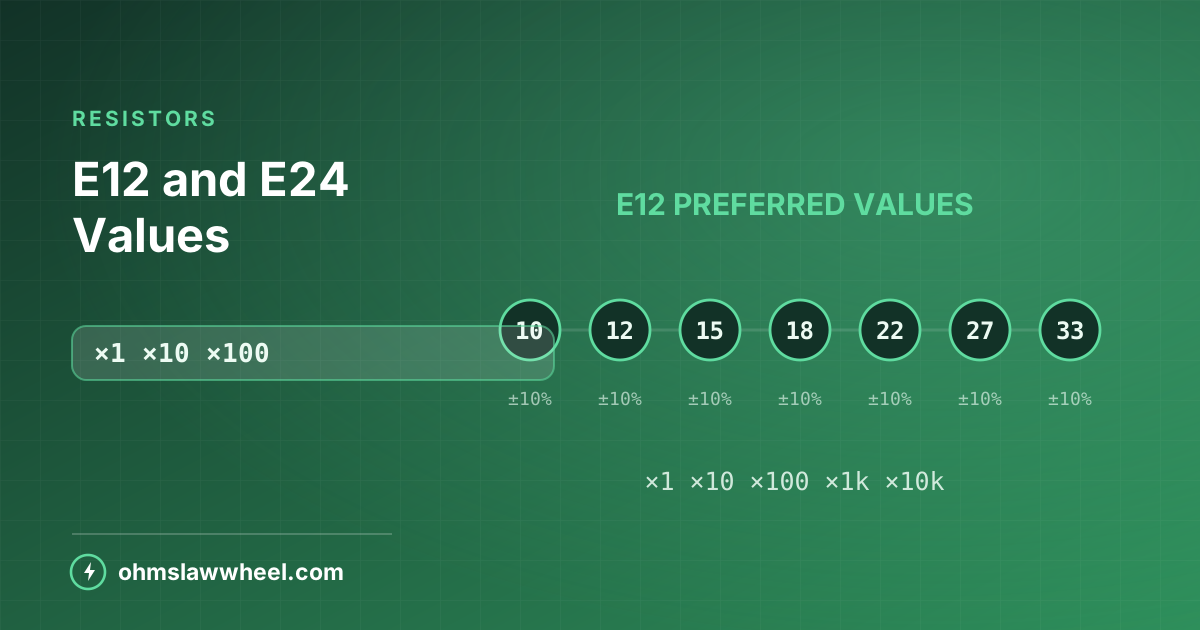
- E12 pairs with ±10%, E24 with ±5%, E96 with ±1%.
Why not just use round numbers?
Because a resistor is sold with a tolerance. A ±10% part marked 10 Ω is anything from 9 to 11 Ω. The next value up should start where that one ends — so it must be about 12 Ω, not 11 or 15.
Follow that logic around a decade and you get twelve values. Each is roughly 1.21 times the last, because the twelfth root of 10 is 1.212.
The general rule
- En steps by the nth root of 10.
- E12: ⁸²√10 ≈ 1.21 → 21% steps, matching ±10% parts.
- E24: ²⁴√10 ≈ 1.10 → 10% steps, matching ±5% parts.
- E96: ≈ 1.024 → 2.4% steps, matching ±1% parts.
The E12 series
| 1 | 2 | 3 | 4 | 5 | 6 |
|---|---|---|---|---|---|
| 10 | 12 | 15 | 18 | 22 | 27 |
| 33 | 39 | 47 | 56 | 68 | 82 |
Multiply any of these by 1, 10, 100, 1 k, 10 k, 100 k or 1 M. That is why 4.7 kΩ, 47 kΩ and 470 kΩ are all common, while 5 kΩ is not stocked anywhere.
Resistor Color Code CalculatorDecode any resistor and see which preferred series its value belongs to.
The E24 series
E24 contains every E12 value plus twelve more between them:
| a | b | c | d | e | f | g | h |
|---|---|---|---|---|---|---|---|
| 10 | 11 | 12 | 13 | 15 | 16 | 18 | 20 |
| 22 | 24 | 27 | 30 | 33 | 36 | 39 | 43 |
| 47 | 51 | 56 | 62 | 68 | 75 | 82 | 91 |
Choosing a series for a design
| Series | Values / decade | Tolerance | Use for |
|---|---|---|---|
| E6 | 6 | ±20% | Legacy, non-critical |
| E12 | 12 | ±10% | Pull-ups, LED limiting |
| E24 | 24 | ±5% | General design work |
| E96 | 96 | ±1% | Dividers, references |
| E192 | 192 | ±0.5% | Instrumentation |
Hitting a value that is not on the list
Suppose a divider calls for 3.3 kΩ but you need 3.4 kΩ:
- Series: 3.3 k + 100 Ω = 3.4 kΩ exactly.
- Parallel: 4.7 k ∥ 12 k = 3.38 kΩ.
- Move to E96, where 3.40 kΩ is a stocked value.
- Re-scale the whole divider so both legs land on preferred values — usually the cleanest fix, since only the ratio matters.
Check any combination with the series or parallel resistor calculator.
A tighter tolerance costs little in surface-mount parts. If a design is sensitive to the exact ratio, specify E96 ±1% rather than trying to combine E24 values.
Preferred values beyond resistors
The same logarithmic spacing appears throughout electronics, because the reasoning about tolerance is identical wherever a component is manufactured to a percentage rather than an absolute figure.
- Capacitors follow E6 or E12 — which is why 100 nF, 220 nF and 470 nF are everywhere and 300 nF is nowhere.
- Inductors use E12 or E24 in the same way.
- Zener diodes follow a similar preferred set: 3.3 V, 3.9 V, 4.7 V, 5.6 V.
Designing so the exact value does not matter
The most robust designs are the ones where a 5% shift changes nothing important. Pull-up resistors, LED current limiters and decoupling networks all work across a wide range of values.
Save the tight-tolerance parts for the places where the ratio genuinely matters — feedback networks, references and measurement dividers — and use whatever is in the drawer everywhere else.
Reading values back
Knowing the preferred series makes colour codes self-checking: if your reading gives 43 kΩ you can trust it, but 44 kΩ almost certainly means a misread band. The resistor color code chart covers the decoding, and Ohms Law Wheel's calculator flags the nearest preferred value automatically.
Frequently asked questions
Why is there no 5k resistor?
Because preferred values are spaced logarithmically to suit tolerance bands. The E24 series jumps from 4.7 kΩ to 5.1 kΩ, and with ±5% parts those two ranges already cover everything in between.
What is the difference between E12 and E24?
E12 has twelve values per decade for ±10% parts; E24 has twenty-four for ±5% parts. E24 includes every E12 value plus one extra between each pair.
Can I make a non-standard resistance from preferred values?
Yes. Series addition or parallel combination reaches almost any value, or you can move up to the E96 series where the spacing is only 2.4%.