Key takeaways
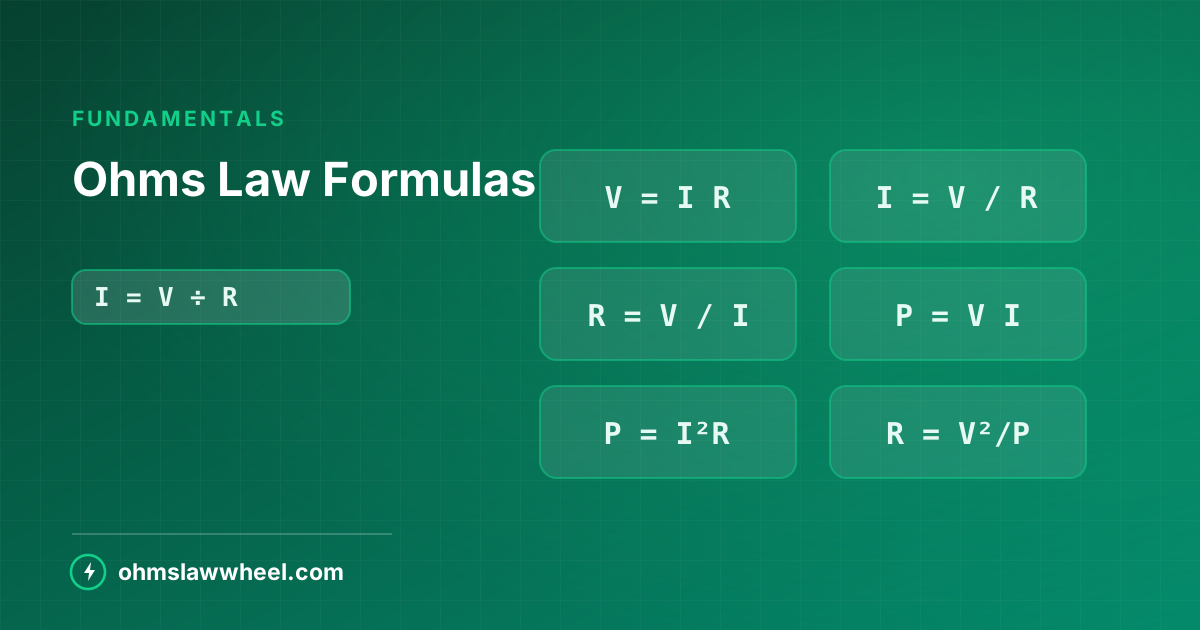
- Two base laws generate every other formula: V = I × R and P = V × I.
- Always convert to base units before substituting numbers.
- The squared forms — P = I²R and P = V²/R — are the ones people misremember.
The two base ohms law formulas
Ohm's law states that the current through a conductor is directly proportional to the voltage across it and inversely proportional to its resistance:
- V = I × R — voltage equals current times resistance
- P = V × I — power equals voltage times current
Everything else in this guide is one of those two, rearranged. The ohms law wheel chart arranges all twelve results visually.
Units and symbols
| Quantity | Symbol | Unit | Named after |
|---|---|---|---|
| Voltage | V | volt (V) | Alessandro Volta |
| Current | I | ampere (A) | André-Marie Ampère |
| Resistance | R | ohm (Ω) | Georg Ohm |
| Power | P | watt (W) | James Watt |
Rearranging for each quantity
Solving for current
Divide both sides of V = I × R by R:
- I = V ÷ R — from voltage and resistance
- I = P ÷ V — from power and voltage
- I = √(P ÷ R) — from power and resistance
Solving for resistance
- R = V ÷ I
- R = V² ÷ P
- R = P ÷ I²
Solving for power
Substituting V = IR into P = VI gives P = I²R. Substituting I = V/R gives P = V²/R.
- P = V × I
- P = I² × R
- P = V² ÷ R
Ohms Law CalculatorEnter any two of voltage, current, resistance or power and get the other two with every step shown.
Worked examples
Example 1 — a resistor on a bench supply
A 470 Ω resistor sits across 9 V.
- Current: 9 ÷ 470 = 19.1 mA
- Power: 9² ÷ 470 = 0.172 W
A quarter-watt part handles that comfortably — see resistor power rating for the margin to allow.
Example 2 — working backwards from a nameplate
A 1500 W heater on 230 V draws I = P ÷ V = 1500 ÷ 230 = 6.52 A, and presents R = V² ÷ P = 52900 ÷ 1500 = 35.3 Ω when hot.
Common mistakes with ohms law formulas
Unit slips cause more errors than algebra. 4.7 kΩ is 4700 Ω, and 20 mA is 0.020 A. Substitute the base-unit values, not the prefixed ones.
- Squaring the wrong term. In P = I²R only the current is squared.
- Using cold resistance for hot components. A tungsten lamp measures a fraction of its operating resistance when cold.
- Applying the formulas across a whole network. Reduce combinations first with the parallel resistor calculator.
- Ignoring cable resistance. On long runs the wire itself drops voltage; our voltage drop calculator accounts for it.
Prefixes and conversions
Most ohms law mistakes are unit mistakes, so it is worth having the multipliers in front of you until they are second nature.
| Prefix | Symbol | Multiply by | Typical use |
|---|---|---|---|
| micro | µ | 0.000001 | Leakage currents, capacitance |
| milli | m | 0.001 | LED and signal currents |
| kilo | k | 1000 | Resistor values, watts |
| mega | M | 1000000 | Pull-down and bias resistors |
A reliable substitution routine
- Write the formula out in symbols before touching any numbers.
- Convert every known value into volts, amperes, ohms or watts.
- Substitute, then carry full precision through the working.
- Round only the final answer, and restate it with a sensible prefix.
That routine costs a few extra seconds and removes almost every factor-of-a-thousand error before it reaches a component.
Which formula should you reach for?
Let the two values you already have decide. If you measured volts and amps, use R = V/I and P = VI. If you know a component's rating and the supply, start from power. Every path leads to the same answer, and the tools at Ohms Law Wheel show the working either way.
Frequently asked questions
What are the three main ohms law formulas?
V = I × R, I = V ÷ R and R = V ÷ I. Adding the power law P = V × I and its rearrangements brings the total to twelve.
Why is power sometimes I squared times R?
Because substituting V = IR into P = VI gives P = (IR)I, which is I²R. It is the same power, expressed using current and resistance instead of voltage.
Do ohms law formulas apply to every component?
They apply to ohmic components whose resistance is constant. Diodes, LEDs and transistors are non-linear, so you use their datasheet curves instead.